
Dental Mounted Stone Materials: Alumina, Silicon Carbide and Arkansas Stone
A practical guide to white, pink, green and Arkansas dental stones—their abrasive materials, properties, applications and ISO 6360-1:2004 material codes.
Dental mounted stones may look similar, but their grinding behavior depends strongly on the abrasive material used in the working part. White and pink stones are commonly based on aluminum oxide, green stones use silicon carbide, while Arkansas stones are made from naturally occurring microcrystalline quartz. This article compares the composition, hardness, grinding characteristics, common dental applications and ISO 6360-1:2004 material codes of these four common dental mounted stone materials.
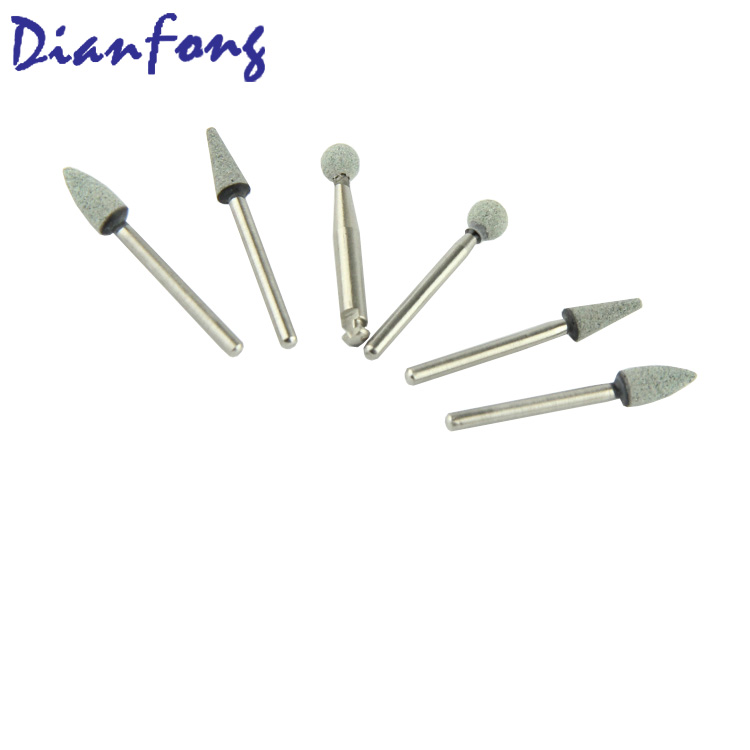
Dental mounted stones are widely used for grinding, contouring and finishing in clinical dentistry and dental laboratories. Although white, pink and green stones may appear to differ mainly in color, the more important difference is the abrasive material that forms the working part of the instrument.
Different abrasive materials have different hardness, toughness and fracture behavior. These properties affect how a mounted stone interacts with enamel, composite resin, porcelain, dental alloys and other restorative materials.
This guide introduces four common dental mounted stone materials: aluminum oxide, pink aluminum oxide, silicon carbide and Arkansas stone. It also explains their corresponding material codes under ISO 6360-1:2004.
1. Aluminum Oxide — White Dental Stones
Aluminum oxide (Al₂O₃), also known as alumina or corundum, is one of the most common abrasive materials used in dental mounted stones. High-grade white aluminum oxide is commonly used to manufacture what are generally called white stones.
What is aluminum oxide?
Aluminum oxide is a very hard abrasive with a Mohs hardness of approximately 9.0. This high hardness allows the abrasive grains to remove material effectively while maintaining useful durability during grinding.
Typical dental applications
In clinical applications, white aluminum oxide stones can be used for adjusting or finishing enamel and composite resin.
In dental laboratories, aluminum oxide stones are also used for grinding high-strength non-precious dental alloys, including nickel-chromium (Ni-Cr) and cobalt-chromium (Co-Cr) alloys.
2. Pink Aluminum Oxide — Pink Dental Stones
Pink dental stones are closely related to white aluminum oxide stones. Their abrasive is also based on aluminum oxide, but a small amount of chromium oxide (Cr₂O₃) is added to the material.
Why is the stone pink?
The characteristic pink or reddish color is associated with chromium oxide in the alumina. As the chromium content increases, the material can develop a stronger red tone.
How is pink alumina different from white alumina?
Both materials have a Mohs hardness of approximately 9.0, but pink aluminum oxide is generally characterized by greater toughness.
This distinction is useful because abrasive performance is determined not only by hardness. The way an abrasive grain resists fracture during use also affects the grinding behavior of the mounted stone.
3. Silicon Carbide — Green Dental Stones
Silicon carbide (SiC), also known as carborundum, is another important abrasive used in dental mounted stones. It is commonly associated with green stones.
Harder, sharper and more brittle
Silicon carbide is harder than aluminum oxide, with a Mohs hardness of approximately 9.2 to 9.5. Its abrasive grains have sharp cutting edges, but the material is also relatively brittle.
During grinding, individual grains can fracture and expose new sharp edges. This behavior is often described as good self-sharpening ability. Instead of simply becoming progressively dull, fractured grains can continue to present fresh cutting points.
Typical dental applications
Green silicon carbide stones are commonly used for adjusting porcelain, composite resin and enamel. Their grinding behavior is particularly useful when working with ceramic materials.
In dental laboratories, silicon carbide mounted stones are also widely used on ceramics, porcelain, cast metals and precious-metal restorations.
Compared with some other grinding materials, green stones can generate relatively low heat during use, which is useful when working with heat-sensitive ceramic restorations.
4. Arkansas Stone — Natural Microcrystalline Quartz
Arkansas stone differs fundamentally from the three abrasive materials discussed above. Instead of being a conventional manufactured abrasive based on alumina or silicon carbide, Arkansas stone is a naturally occurring fine-grained stone.
What is Arkansas stone made from?
Arkansas stone is a form of microcrystalline quartz composed primarily of silicon dioxide (SiO₂). It is also known mineralogically as novaculite.
The material has a Mohs hardness of approximately 7.0. It normally has a white or off-white appearance and a very fine, dense structure. Because it is a natural material, slight variations in color may occur due to trace impurities.
Typical dental applications
Arkansas stones are primarily associated with fine finishing rather than aggressive material removal. In clinical dentistry, they can be used for very fine finishing of composite restorations, filling materials and tooth margins.
Their relatively fine abrasive action makes them useful when the objective is controlled surface refinement rather than rapid grinding.
5. White, Pink, Green and Arkansas Stones: Material Comparison
The color of a dental stone is often the easiest feature to recognize, but the underlying abrasive material provides a more useful explanation of how the instrument behaves.
| Dental Stone | Main Abrasive Material | Mohs Hardness | Main Characteristic | Typical Applications | ISO Material Code |
|---|---|---|---|---|---|
| White Stone | High-grade white aluminum oxide | ≈ 9.0 | Hard and durable abrasive | Enamel, composite, Ni-Cr and Co-Cr alloys | 63 |
| Pink Stone | Pink aluminum oxide with chromium oxide | ≈ 9.0 | Greater toughness than standard alumina | Dental grinding and finishing applications | 62 |
| Green Stone | Silicon carbide | ≈ 9.2–9.5 | Hard, sharp, brittle and self-sharpening | Porcelain, ceramics, composite, enamel and metals | 65 |
| Arkansas Stone | Microcrystalline quartz / novaculite | ≈ 7.0 | Fine natural abrasive | Fine finishing of composite, filling materials and tooth margins | 60 |
6. Understanding ISO 6360-1:2004 Material Codes
ISO 6360 provides a numerical coding system for dental rotary instruments. For mounted stones, the material of the working part is an important part of this identification system.
The four materials discussed in this article are represented by the following material codes:
- 60 — Quartz
- 62 — High-grade corundum, pink
- 63 — High-grade corundum, white
- 65 — Silicon carbide
For ceramic-bonded abrasive stones, the binding code 5 may appear as the third digit. This produces familiar three-digit combinations such as 625, 635 and 655.
Conclusion
White, pink, green and Arkansas dental stones are not simply different colors of the same instrument. They are based on different abrasive materials with different mechanical characteristics.
White aluminum oxide provides a hard and durable abrasive, while pink aluminum oxide offers a tougher variation of alumina. Silicon carbide is harder, sharper and more brittle, giving it strong self-sharpening behavior, while Arkansas stone provides a much finer natural quartz-based abrasive for controlled finishing.
Understanding these material differences makes it easier to select an appropriate dental mounted stone for enamel, composite resin, porcelain, ceramics or dental alloys—and also makes the material codes in ISO 6360-1:2004 considerably easier to understand.