
Grinding vs. Polishing Zirconia Why Surface Roughness Matters
Zirconia restorations often require grinding, finishing, and polishing after sintering. Although grinding establishes the correct shape, it can leave microscopic scratches that affect surface quality, antagonist tooth wear, and plaque retention. Understanding the purpose of each processing stage helps produce a smoother, safer, and more durable zirconia surface.
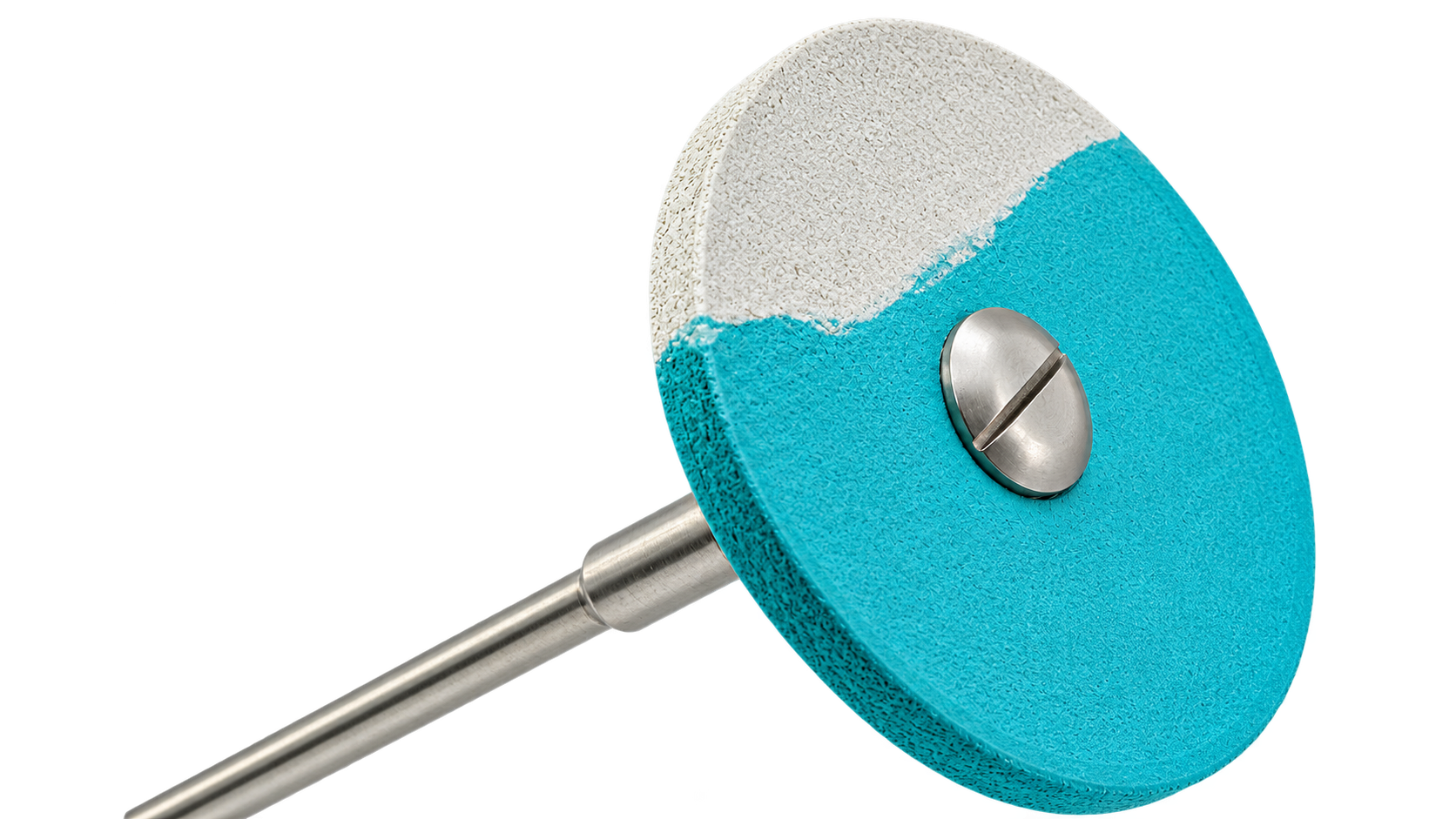
In modern dentistry, zirconia is widely used for crowns, bridges, and other dental restorations. It offers high strength and good wear resistance, and its appearance can be made close to that of natural teeth.
After a zirconia restoration has been sintered, the technician may still need to adjust it according to the actual situation, such as modifying occlusal contacts, refining the margins, or correcting the contour.
At this point, we often encounter two procedures that may look similar but actually serve very different purposes:
Grinding and polishing.
1. Grinding and Polishing
If part of a zirconia crown is over-contoured, it may interfere with normal occlusion. The excess material therefore needs to be removed.
Technicians usually use a diamond bur or another grinding tool to remove a small amount of zirconia. This type of process, whose main purpose is to remove material and change the shape, is called grinding.
Grinding can quickly change the shape of the material. At the same time, however, the abrasive particles on the grinding tool leave many small, difficult-to-see scratches on the surface.
When the surface is viewed under magnification, many tiny peaks, valleys, and grooves can be seen.
The purpose of polishing is to address these small scratches. By gradually using finer abrasives, the irregular surface becomes smoother and more visually pleasing.
Good polishing is usually not completed in a single step. Many zirconia polishing systems are divided into several polishing stages:
- Coarse polishing
- Medium polishing
- Fine polishing
Each stage has a different task.
Coarse polishing requires relatively strong cutting ability to address the deeper scratches left after grinding.
Medium polishing further reduces the marks left by the first stage.
Fine polishing then further reduces subtle surface irregularities and scratches.
In effect, each polishing tool deals with the scratches left by the previous stage.
If an intermediate stage is skipped and a very fine polishing tool is used directly on a very rough surface, the restoration may develop some shine, but the deeper scratches may still not be removed sufficiently.
Simply put, grinding is mainly used to remove material and change the shape, while polishing is mainly used to improve the surface and make it smooth and glossy again.
2. Is Quick Grinding All You Need?
For a grinding tool, material removal efficiency is certainly important.
If a tool cannot cut zirconia effectively at all, it has little practical value.
However, simply pursuing a higher material removal rate does not necessarily improve the efficiency of the overall procedure.
If excessive material removal efficiency comes at the cost of leaving many deep scratches, the later polishing stages will require more time to address those surface defects.
A reasonable workflow should therefore consider the entire process, rather than focusing on only one step.
3. What Is Finishing?
In the field of dental rotary instruments, grinding, finishing, and polishing are three very common terms.
Once we understand grinding and polishing, the concept of finishing is not difficult to grasp.
Finishing can be understood as a connecting step between grinding and polishing. It is mainly used to reduce visible grinding marks and refine the surface further, without changing the overall form as extensively as grinding does.
Grinding, finishing, and polishing can be viewed as a complete process that gradually shifts from material removal to surface optimization.
4. Is It Enough for the Surface to Look Smooth?
Suppose a zirconia crown already looks fairly smooth and has a relatively even surface after grinding. Can polishing be skipped so that the crown can be used directly?
Polishing is not only intended to make a restoration look better. It is also a functional surface-treatment step.
Our eyes can see relatively large surface defects, but it is difficult for us to notice small defects on a microscopic scale.
Many surface defects become clearly visible only under magnification.
Therefore, even if a ground zirconia crown already appears quite smooth, it usually still needs to be polished thoroughly.
5. Why Does Zirconia Surface Roughness Matter?
Zirconia is a commonly used dental material. It is a ceramic with high hardness and good biocompatibility.
In the mouth, a zirconia crown repeatedly comes into contact with the opposing tooth, also known as the antagonist tooth.
This repeated contact and friction are especially common during chewing.
Many studies have shown that well-polished zirconia generally causes significantly less wear to the antagonist tooth than rough or insufficiently polished zirconia.
From another perspective, a rough crown surface also provides more favorable conditions for bacterial adhesion and plaque formation.
Some classic studies have identified an Ra value of approximately 0.2 µm as a reference threshold for plaque retention on hard materials in the oral environment.
When surface roughness exceeds this level, a further increase in roughness may be accompanied by greater plaque accumulation.
Of course, plaque formation is also affected by material properties, saliva, the oral environment, and many other factors. Ra should therefore not be regarded as the only criterion for evaluating plaque adhesion.
Within a reasonable range, reducing surface roughness generally helps reduce the problems associated with plaque adhesion.
For dental restorations, a zirconia crown with lower surface roughness can therefore not only reduce wear on the enamel of the opposing tooth, but also help improve oral hygiene conditions.
6. Glazing: Another Surface Treatment
Another common surface treatment for zirconia restorations is called glazing.
Glazing creates a thin, glass-like glaze layer on the zirconia surface, thereby reducing surface roughness.
From a visual perspective, glazing can usually improve the gloss and appearance of a restoration noticeably.
However, glazing and polishing are not exactly the same. For zirconia that has been adjusted by grinding, glazing should not simply be regarded as an equivalent substitute for polishing.
One reason is that the glaze layer itself may gradually wear away during long-term chewing.
Some studies have found that a well mechanically polished zirconia surface can be smoother than certain glazed surfaces and can cause less wear to the antagonist tooth.
Once part of the glaze layer has worn away, the zirconia surface underneath may be exposed again if it was not polished sufficiently.
Glazing and polishing should therefore be understood as two surface treatments with different purposes and mechanisms.
Glazing can improve the gloss and appearance of a restoration, but for areas that have been adjusted by grinding, thorough polishing remains an important way to reduce surface roughness.
7. Conclusion
Zirconia processing follows a relatively mature sequence of steps.
For a zirconia restoration that has been adjusted by grinding, a more reasonable approach is to establish the correct form first and then improve the surface step by step.
Grinding is mainly responsible for removing material and adjusting the form. Finishing further refines the surface left by grinding, while polishing gradually shifts the focus from material removal to final surface quality.
For a zirconia restoration, grinding determines its shape, while thorough surface treatment determines the surface condition in which that shape ultimately enters the mouth.
Final surface roughness affects more than the gloss of a restoration. It also relates to the wear produced when the restoration contacts the antagonist tooth, as well as the conditions that allow bacteria and plaque to remain on the surface.