
PC Series Dental Cleaning Burs: Cleaning, Debonding and Finishing
A simple introduction to bonded-abrasive cleaning burs for stain removal, bracket cleanup and fine surface finishing.
The PC Series is a bonded-abrasive dental cleaning instrument designed for stain and calculus removal, bracket debonding, and surface refinement. This article explains how the Medium and Fine grades, RA and FG shanks, and different working shapes fit into common dental cleaning and finishing workflows.
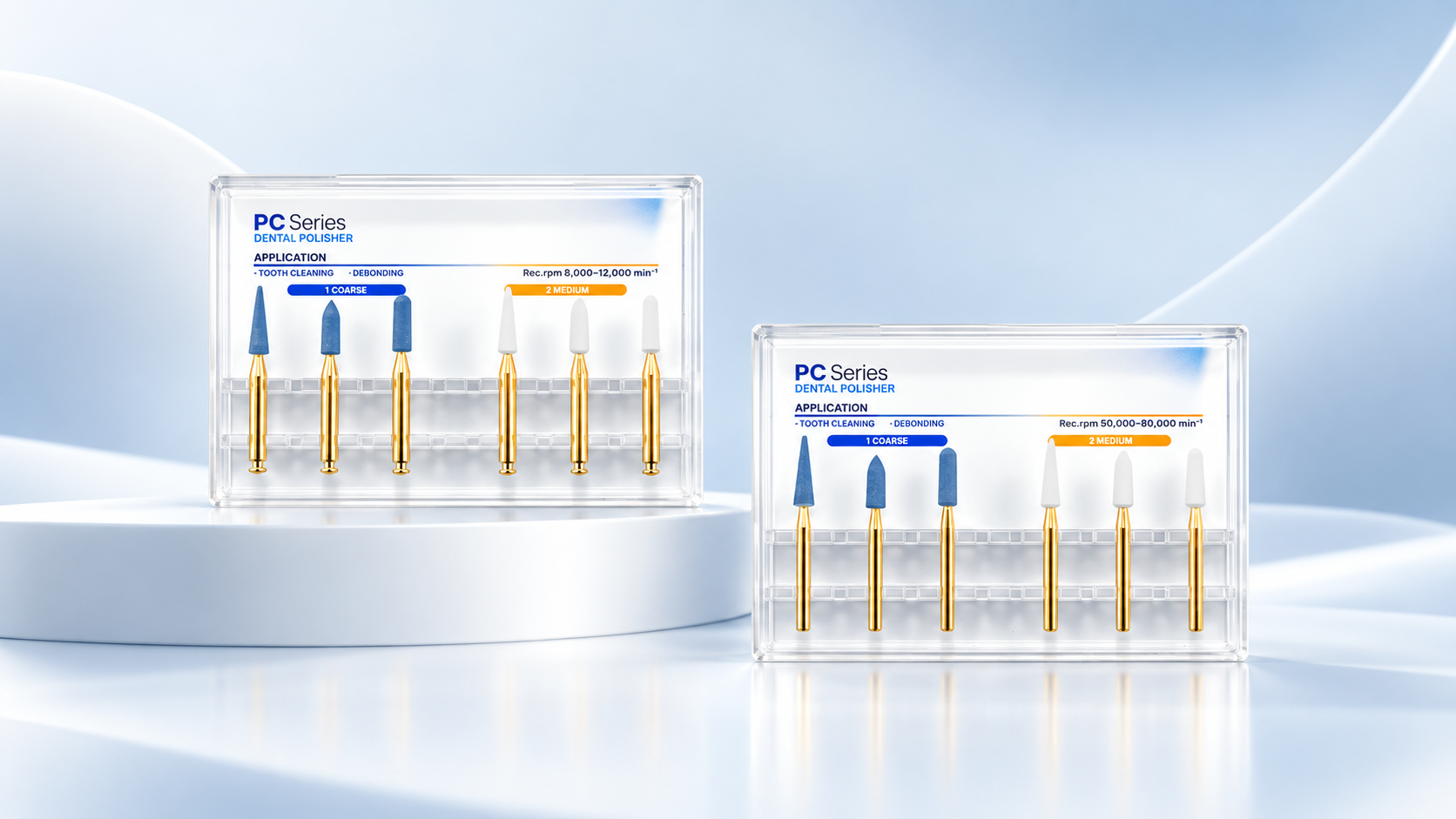
Dental cleaning is not always about removing as much material as possible.
In many procedures, the real goal is more controlled: removing stains, calculus, residual bonding material, or small surface irregularities while keeping the underlying tooth surface in mind.
This is the main idea behind our PC Series.
The PC Series is a bonded-abrasive dental cleaning instrument available in different shapes, grits, and shank types. It can be used for dental cleaning and bracket debonding, while the FG-shank PCF series also extends into preparation finishing and pre-polishing.
In this article, we will take a simple look at what this type of dental cleaning bur is, how it works, and where it may fit into a normal rotary-instrument workflow.
What Is a Dental Cleaning Bur?
We usually call the PC Series a dental cleaning bur, but technically it works somewhat differently from a conventional carbide bur.
A carbide bur removes material mainly through its cutting blades. A diamond bur uses abrasive diamond particles on its working surface.
The PC Series is different. Its working head is made as a bonded abrasive structure.
In the current PC Series, aluminum oxide is used as the abrasive, together with a ceramic binder.
Instead of relying on cutting blades, the head works through abrasive contact with the surface. This makes the product suitable for jobs where cleaning, finishing, and gradual surface refinement are more important than heavy cutting.
This type of instrument sits somewhere between a cleaning tool and a finishing abrasive.
What Can the PC Series Be Used For?
The PC Series is mainly intended for three types of work:
- dental cleaning, including calculus and surface stain removal;
- bracket debonding and cleanup of residual bonding material;
- preparation finishing and pre-polishing with the FG-shank PCF series.
These applications do not all require the same amount of abrasion, which is why the PC Series is available in different grits and shank configurations.
Calculus and Surface Stain Removal
One of the main uses of the PC Series is routine dental cleaning.
Surface stains and calculus may require some mechanical removal, but aggressive cutting is not always the objective. A bonded abrasive gives the operator another way to approach this type of cleaning.
The PC Series can be used to help remove deposits and stains from the tooth surface using a rotary handpiece.
For this type of work, the PCR series with RA shank is the main option in the product range.
The recommended working speed shown for the PCR series is 8,000-12,000 rpm.
The amount of material removed will still depend on factors such as pressure, contact time, grit, and the surface being treated. Like other rotary abrasives, it should be used with controlled contact rather than simply pressing harder.
Bracket Debonding and Adhesive Cleanup
After orthodontic brackets are removed, some bonding material may remain on the tooth surface.
This is another application for the PC Series.
The purpose here is not simply to cut quickly. The operator needs to remove the unwanted material and then gradually refine the surface.
A bonded abrasive can be useful for this type of cleanup because the working action is different from that of a bladed carbide bur or an electroplated diamond bur.
The PC Series is therefore designed not only for dental cleaning, but also for bracket debonding and post-debonding cleanup. This is also one of the main applications listed for the series.
Depending on how much bonding material remains, the operator can choose between the Medium and Fine versions or use them as different stages of the finishing process.
Medium and Fine: Two Levels of Abrasion
The PC Series is currently divided into two working grades:
M - Medium / Pre-Polishing
F - Fine / Polishing
The Medium version is intended for situations where somewhat stronger cleaning or initial surface refinement is needed.
The Fine version provides a gentler finishing step and can be used when the surface has already been largely cleaned and requires further refinement.
The two grades do not have to be used together in every procedure.
For a small amount of stain or adhesive residue, the Fine version may be sufficient. For heavier deposits or more material to remove, the Medium version may be a more practical starting point.
The choice depends on the surface condition, the procedure, and the operator's preferred technique.
PCR and PCF: RA and FG Versions
The PC Series is available with two different shank systems.
The PCR series uses an RA shank and is intended mainly for lower-speed cleaning and debonding procedures.
The PCF series uses an FG shank and is designed for higher-speed use.
This difference is more than just the type of handpiece.
The PCF series also expands the application of the product into preparation finishing and pre-polishing.
According to the current product specification, the recommended working speed is:
| Series | Shank | Recommended Speed | Main Role |
|---|---|---|---|
| PCR | RA | 8,000-12,000 rpm | Cleaning and bracket debonding |
| PCF | FG | 50,000-80,000 rpm | Cleaning, fine finishing and pre-polishing |
These speed ranges are part of the current PC Series specifications.
Using PCF for Preparation Finishing
During tooth preparation, different rotary instruments may be used at different stages.
A diamond bur is commonly used for shaping and contouring. As the procedure moves toward the finishing stage, however, the objective gradually changes.
Instead of removing a large amount of material, the operator may want to reduce small surface irregularities and refine the prepared surface.
This is where the PCF series may be useful.
The current PC Series is positioned for preparation finishing or pre-polishing, with a working effect intended to be comparable to the finer stage of a red-ring diamond bur in some applications.
We would not describe PCF as a universal replacement for a fine diamond bur.
The two instruments work differently and can serve different purposes.
A diamond bur is still an important tool for cutting, shaping, and finishing. PCF is better understood as another option when the procedure begins to move away from contouring and toward finer surface refinement.
Depending on the clinical situation and the operator's technique, it may be used after diamond preparation or as part of a pre-polishing step.
Three Working Shapes
The PC Series is available in three main head shapes: 172, 249, and 141.
The current sizes include heads around 2.3 mm in diameter, with working lengths of approximately 7-9 mm depending on the shape.
These different profiles give the operator several options for different access angles and working areas.
Rather than assigning one strict clinical indication to each shape, it is more practical to choose according to the surface being treated and personal handling preference.
The same three basic shapes are available across the Medium and Fine grades, making it easier to keep a familiar head shape while changing the level of abrasion.
What Is New in the Current PC Series?
The current generation of the PC Series uses a revised abrasive system.
The working head now combines an aluminum-oxide abrasive with a ceramic binder.
The change is mainly a material-system update rather than a completely different way of using the product.
The general purpose remains the same: cleaning, debonding, and controlled surface refinement.
For users who are already familiar with this type of bonded-abrasive cleaning instrument, the new version is therefore intended to keep a familiar workflow while using a different abrasive and binder system.
At this stage, we prefer not to make numerical claims about cutting efficiency, service life, surface roughness, or other performance differences without sufficient comparative testing.
What we can say more clearly is what the product is designed to do and where it fits in the dental rotary workflow.
Where Does a Cleaning Bur Fit Among Other Rotary Instruments?
There is no single rotary instrument that is ideal for every step.
Carbide burs are useful when material needs to be cut with blades.
Diamond burs are widely used for tooth preparation, contouring, and finishing.
Bonded abrasives such as the PC Series have a different role.
They are more closely associated with cleaning, debonding, and progressive surface refinement.
This means the PC Series should not be considered a replacement for all carbide or diamond burs.
Instead, it gives the operator another type of abrasive instrument for stages where controlled cleaning or finishing is the main objective.
In a typical workflow, a diamond or carbide instrument may perform the major cutting or shaping first, while a bonded abrasive can be introduced later when less aggressive surface refinement is preferred.
Choosing a PC Series Instrument
Choosing between the different PC instruments can be kept relatively simple.
For general dental cleaning and bracket debonding, the PCR RA-shank series is the main starting point.
For preparation finishing or higher-speed pre-polishing, the PCF FG-shank series may be more suitable.
Within either series, Medium can be selected when more initial cleaning or abrasion is needed, while Fine can be used for a lighter finishing step.
The 172, 249, and 141 shapes then allow the operator to choose the head profile that feels most suitable for the working area.
Final Thoughts
Dental cleaning and finishing are not only about removing material. They are also about choosing an instrument that matches the stage of the procedure.
The PC Series is a bonded-abrasive dental cleaning system built around this idea.
With Medium and Fine grades, RA and FG shanks, and several working shapes, the range can cover different stages from stain and calculus removal to bracket cleanup and fine preparation finishing.
The current generation uses aluminum oxide with a ceramic binder, while keeping the basic PC Series concept focused on cleaning and controlled surface refinement.
As with any rotary abrasive, the best choice depends on the surface, the amount of material to remove, the handpiece, and the operator's technique.